


Cart
0

Drying oak wood: what really matters
Anyone who wants to dry oak wood usually has a specific goal: a table, a staircase, floorboards or furniture that will not warp or crack after installation. What matters is not whether the delivery note says “air-dried” or “kiln-dried”, but the actual moisture content of the wood and whether it suits the place where it will be used. In this guide we explain how long oak takes to air-dry, what kiln drying achieves, which moisture content is usual for furniture and floors, and how to store sawn timber correctly.
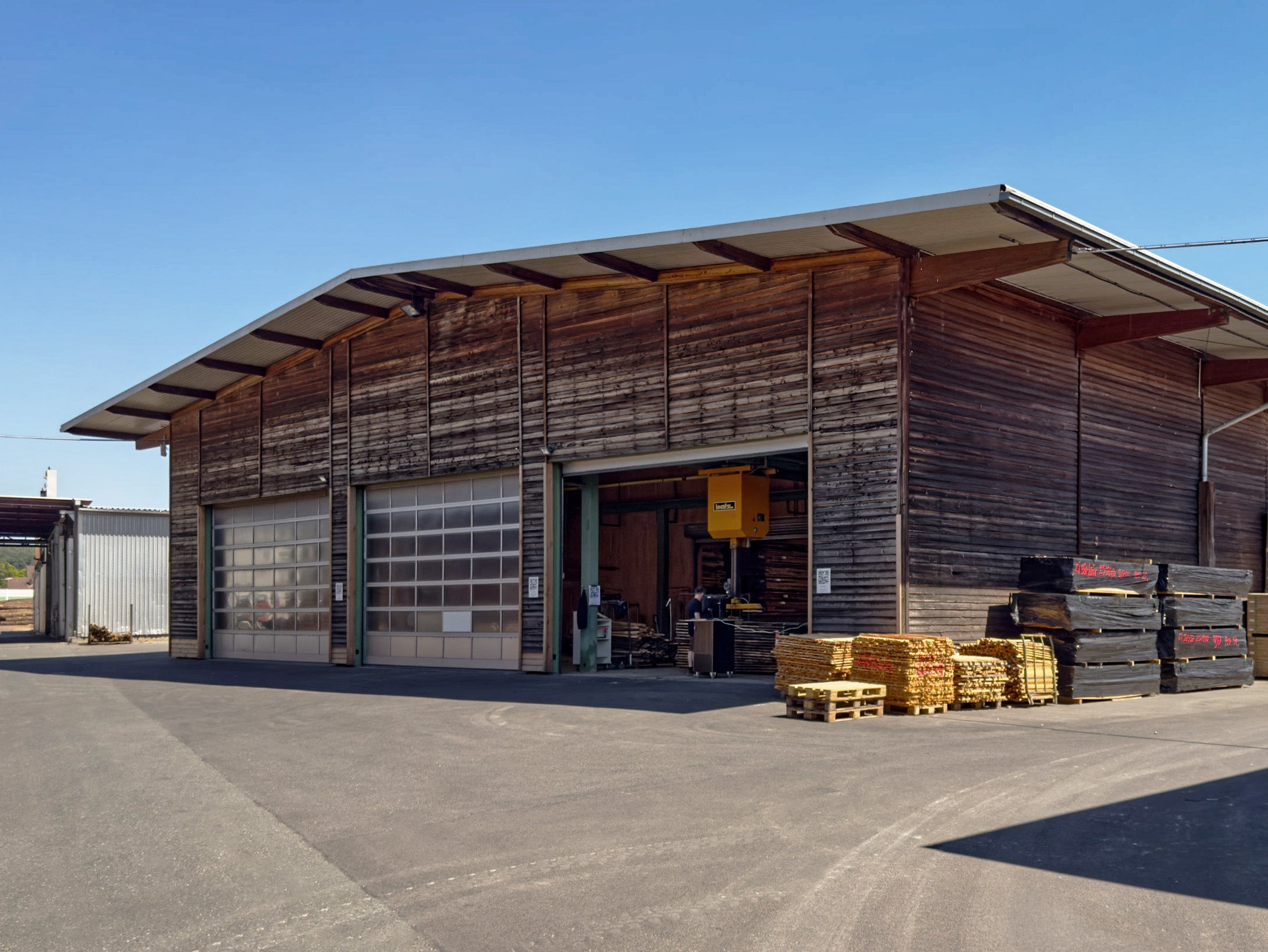
We write from practical experience: Gunreben is a sawmill and parquet manufacturer in Strullendorf near Bamberg, Germany. After sawing, our oak is air-dried for one to three years depending on species and thickness, and then brought to the required target moisture in our own drying kilns.
Quick decision guide
- Furniture, table tops, stairs, parquet in heated interiors: use kiln-dried oak (KD). In Central Europe, air drying alone is usually not enough for this.
- Outdoors, fences, garden projects, covered structures: air-dried timber (AD) is often sufficient here, because the wood adapts to the outdoor air anyway.
- Drying freshly sawn timber yourself: a rough rule of thumb is about one year of air drying per centimetre of thickness, for oak rather more. After that, the wood is air-dry but not yet dry enough for furniture.
- Before buying: ask for the measured moisture content, not just whether it is “dry”.
- Before processing: store the wood for a few weeks in the climate of the workshop or the room where it will be installed.
Matching products from Gunreben:
Unedged oak sawn timber – boules in seven grades and thicknesses from 20 to 80 mm, kiln-dried (KD), for collection at the sawn timber yard in Strullendorf or on request.
Solid wood panel 20 mm oak A/B – ready glued and, according to the product data, kiln-dried to approx. 8 % moisture content, ready to use.
Solid wood panel 30 mm knotty oak B – rustic panel with knots for furniture and shelves, if you do not want to dry and glue the wood yourself.
Solid oak floorboard Markant 20 × 200 mm – ready-profiled oak board for living spaces, unfinished and sanded.
Air-dried or kiln-dried? The difference
Air-dried wood (often labelled AD) dries outdoors under a roof. Wind and outdoor air slowly draw water out of it until it reaches the moisture content that matches the surrounding air. In our climate, this equilibrium moisture content outdoors usually lies somewhere between about 12 and 20 %, depending on the season. Wood cannot get drier than that in the open air, no matter how long it is stored.
Kiln-dried or technically dried wood (KD) is dried in a drying kiln with controlled temperature, humidity and air flow. This makes it possible to set a specific target moisture below that of outdoor air, for example for heated living spaces.
| Feature | Air-dried (AD) | Kiln-dried / technically dried (KD) |
|---|---|---|
| Achievable moisture content | only down to the equilibrium moisture of outdoor air, in Central Europe usually around 12 to 20 % | can be set specifically, for interiors usually around 8 to 10 % |
| Duration for oak | several years, depending on thickness | depends on thickness and initial moisture, deliberately slow for oak |
| Control | depends on weather, storage location and stacking | temperature, humidity and air flow are regulated and measured |
| Typical use | outdoors, fencing and garden projects, pre-drying | furniture, table tops, stairs, parquet, interior fit-out |
| What to watch | stacking, roof, air flow, end grain protection | gentle schedule for oak, measure moisture after drying |
In practice, both methods are often combined: freshly sawn timber is first pre-dried in the air, then the kiln brings it to the final moisture content. This is also how we work with our oak sawn timber. It is gentler on the wood and shortens the time in the kiln.

Drying oak wood: how long does it take?
The most common question about drying sawn timber is “how long?”. A widely used rule of thumb for air drying is: about one year per centimetre of thickness. For a 52 mm oak plank that would be around five years. This rule is only a rough guide. Oak dries more slowly than many softwoods, and storage location, stacking and weather change the duration considerably.
- Thin boards (20 to 26 mm): reach air-dry condition after about two to three years if stacked well.
- Planks (40 to 52 mm): need rather four to five years or more in the air.
- Thick planks (65 mm and more): dry very slowly in the air, and the risk of cracks increases.
Important: even after this time the wood is only air-dry. For furniture in heated rooms it must then be kiln-dried or left to dry for a long time in the room climate, which is hardly practical for thick planks.
How long does kiln drying take?
The duration of technical drying depends heavily on species, thickness and initial moisture. Oak needs a much slower, gentler process than softwood, because it tends to crack and discolour if dried too quickly. Pre-dried timber is ready sooner than freshly sawn wood. A reputable kiln operator will therefore only give you a duration once species, thickness and measurements are known.
What moisture content does oak need for furniture, floors and outdoors?
Wood always adapts its moisture to its surroundings. It absorbs or releases moisture and changes its dimensions in the process. That is why oak should be processed at roughly the moisture content it will later reach where it is used. The following values are common guidelines. In each case, the specifications of the manufacturer, the installation instructions or the planner apply.
| Place of use | Usual moisture content | Note |
|---|---|---|
| Furniture, table tops, stairs in heated living spaces | about 8 to 10 % | kiln-dried wood, acclimatise before processing |
| Parquet and floorboards, also with underfloor heating | usually 7 to 11 %, depending on the product | follow the installation instructions |
| Unheated rooms, covered areas | about 12 to 15 % | air-dry or kiln pre-dried timber |
| Outdoors, exposed to weather | varies with the weather, often 15 to 20 % and more | plan structural wood protection and distance from the ground |
According to our grading description, our unedged oak is kiln-dried to a target moisture of 9 % ± 2 %. For solid wood panels such as the solid wood panel 40 mm oak A/B, the product data states kiln drying to approx. 8 %.
Measuring moisture content correctly
In practice, a wood moisture meter with pin electrodes is usually sufficient. Do not measure at the end of the board, which dries faster, but roughly in the middle of its length and, if possible, at different depths. In thick planks the core can be considerably wetter than the surface. Set the wood species on the meter, because oak has a different calibration curve than spruce or beech. The most accurate method is the oven-dry test, in which a sample is weighed, dried and weighed again.
Drying and storing sawn timber: how to stack it correctly
If you want to air-dry freshly sawn oak yourself, the stack determines the result. These points have proven useful:
- Base: place the stack on stable, level bearers or plinths with sufficient distance from the ground so that air can flow underneath and no ground moisture rises.
- Stickers: place dry stickers of equal thickness between each layer, exactly vertically above one another and at short intervals. This keeps the boards flat and reduces warping.
- Gaps between boards: leave small gaps at the sides of wide boards so that air also flows through the stack.
- Roof instead of tarpaulin: protect the stack from rain and direct sun with a roof or cover boards, but leave the sides open. A tight tarpaulin keeps the moisture in the stack.
- Weighting: a weight on the top layer helps prevent the upper boards from warping.
- Protect the end grain: seal the ends of fresh boards with an end grain sealer. Wood dries much faster through the end grain than through the face, and that is where the typical end checks develop.
Would you like to bring the wood to furniture moisture afterwards? Then technical drying is the safer route. We offer it as contract drying, see below.

Drying oak wood without cracks: the most common mistakes
Oak is dense and rich in tannins. This makes it more demanding to dry than many other woods. Most damage occurs when the wood dries too quickly or too unevenly.
- Drying too fast: anyone who wants to dry oak “quickly”, for example in full sun, next to a radiator or in a warm boiler room, risks surface and internal cracks. The outer layer shrinks while the core is still wet.
- Unprotected end grain: without protecting the ends, fresh boards often split from the ends.
- Pith in the board: boards and planks containing the pith are more prone to cracking. For furniture, the pith is therefore usually cut out.
- Uneven stickers: stickers of different thickness or misaligned stickers lead to warping.
- Discolouration: wet, tannin-rich oak can develop dark stains in contact with iron (nails, steel supports). Stripes can also form under stickers if stored incorrectly.
- Processing straight from storage: even kiln-dried wood absorbs moisture again in a cold, damp hall. Store it in the room climate before processing.
Cracks, knots and, depending on the grade, insect galleries can also be desirable in oak, for example for rustic tables. How such features are classified according to the standard is explained in the article DIN 4074-5: classifying galleries of fresh-wood insects. More about oak with insect marks as a design feature can be found on our page beetle oak.
Buy kiln-dried wood or have your own wood dried?
For most interior projects, the easiest option is to buy kiln-dried wood. If you have your own wood, for example from your own forest or from sawing your own logs, you can have it dried.
Contract drying at Gunreben
We carry out technical drying of sawn timber for timber merchants, sawmills, processing companies and also for private customers. We dry sawn timber from 20 to 120 mm thickness, freshly sawn or air-dry, to the required target moisture. We process hardwoods such as oak, beech and ash, softwoods such as pine, larch and spruce, and various tropical woods. On request we also steam and plane the wood, and transport with our own truck is possible by arrangement. All details can be found on the page contract drying and planing.

Which dried oak suits which project?
- Dining table or desk made of planks: kiln-dried strip grade or furniture/stair grade in 40 or 52 mm from the sawn timber yard. Tips on grade and thickness in the guide oak planks for table tops.
- Furniture without drying and gluing yourself: ready-made panels such as the solid wood panel 26 mm oak A/B or the rustic solid wood panel 40 mm knotty oak B. All thicknesses under solid wood panels.
- Stairs: furniture/stair grade or ready-made stair tread panels, for example the stair tread panel 40 mm knotty oak.
- Wooden floor: ready-dried and profiled boards instead of raw timber, for example from the collection solid oak floorboards. Which lengths are available is explained in the article system lengths or fixed lengths?
- Outdoors: different rules apply here for moisture and fixing. More in the article working oak correctly as decking.
- Your own wood from sawing: pre-dry it in the air and then bring it to the target moisture through contract drying.
Conclusion: set the target moisture first, then dry
When drying oak wood, the moisture content at the place of use is what counts. Air drying brings oak to outdoor-air level over several years and is sufficient for outdoor use. For furniture, table tops, stairs and floors in heated rooms you need kiln-dried wood with about 8 to 10 % moisture content. Measure before processing and let the wood acclimatise to the room climate.
Looking for kiln-dried oak or want to have your own wood dried? Request your grade, thickness and quantity directly on our page unedged oak sawn timber or write to saegewerk@gunreben.de. For contract drying, send us the species, quantity and desired target moisture via the page contract work. Order ready-made panels directly online in the collection solid wood panels.
FAQ on drying oak wood
Answers to common questions about drying time, moisture content and storage.
In the air, a rough rule of thumb is about one year per centimetre of thickness, for oak rather more. After that the wood is air-dry. For furniture in heated rooms it must additionally be kiln-dried.
For furniture in heated interiors, usually not. Air-dried wood only reaches the moisture of the outdoor air, usually around 12 to 20 %. Furniture needs about 8 to 10 %. Otherwise the wood shrinks after installation and gaps or cracks appear.
AD stands for “air dried”. KD stands for “kiln dried”, i.e. technically dried in a kiln. Also ask for the measured moisture content, because the abbreviation alone says nothing about the exact value.
We advise against it. Oak cracks and discolours easily if it dries too quickly, for example in the sun or next to a radiator. Even in the drying kiln, oak is dried with a deliberately slow, gentle schedule.
No. Wood always adapts to its surroundings. If kiln-dried wood is stored in a damp, unheated hall, it absorbs moisture again. Store it dry and, before processing, for a few weeks in the climate of the room where it will be used.